
Probes 0.x
Deep-space probes, such as Voyager 1, New Horizons and JWST, have no TLEs: SGP4 is for Earth orbit. Their positions are published as ephemerides, tables of positions and velocities over time, computed by the missions' navigation teams and published by JPL Horizons, or exchanged between agencies as CCSDS Orbit Ephemeris Messages.
The probes snapshot
PROBES holds thirteen notable probes, with an ephemeris for each from JPL Horizons, from 1 November 2026 to 31 December 2027: where Voyager 1 is, how far New Horizons has gone, where JWST sits.
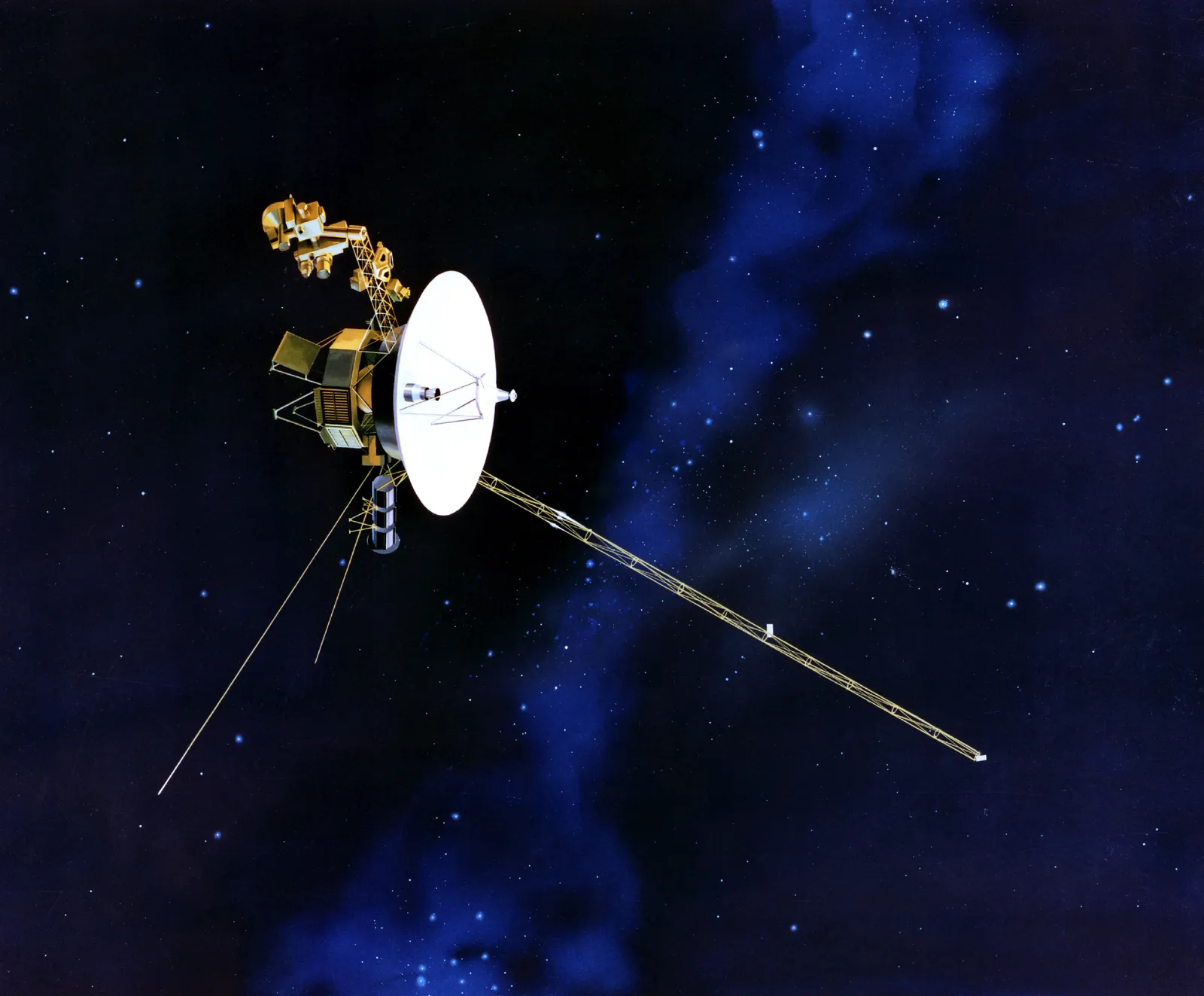
Voyager, in an artist's concept. The twin probes, launched sixteen days apart in 1977, are the same: a 3.7 m dish to talk to Earth, a boom of science instruments, and a 13 m boom that holds the magnetometer away from the spacecraft. Both are still sending data, from beyond the heliopause.
import {
  AU_METERS,
  SPEED_OF_LIGHT_M_PER_S
} from '@interstellar-tools/constants';
import { PROBES, stateAt } from '@interstellar-tools/tracking';

const date = new Date('2026-11-05T00:00:00Z');
const voyager1 = PROBES.find(({ id }) => id === 'voyager-1')!;
const { r, v } = stateAt(voyager1.ephemeris, date); // from the Sun, m and m/s
const au = Math.hypot(...r) / AU_METERS; // ≈ 172.26
const hours = Math.hypot(...r) / SPEED_OF_LIGHT_M_PER_S / 3600; // ≈ 23.88
const speed = Math.hypot(...v); // ≈ 16 920 m/s, leaving the Solar System
Light from the Sun takes almost a day to reach it. Each probe also has its agencies, launch date, status, what it's near ('sun', or 'sun-earth-l2' for JWST) and where it's headed, as ids from the body datasets in @interstellar-tools/constants. New Horizons is 65.99 au out; JWST, at Sun-Earth L2, is 1.00 au from the Sun, just beyond Earth.
Positions are from the Sun's centre, in the ICRF. For one from Earth, subtract Earth's position: from Horizons, or roughly from sunPosition in @interstellar-tools/equations, which gives the Sun from Earth.
Out of the Sun's bubble
The solar wind blows a bubble into the gas between the stars: the heliosphere. Where the wind slows below the speed of sound is the termination shock, and where it meets the interstellar gas is the heliopause. The Voyagers have crossed both, and HELIOSPHERE keeps where and when:
import { HELIOSPHERE } from '@interstellar-tools/constants';

const { astropause, crossings } = HELIOSPHERE;
const nose = astropause!.nose!.value; // 115: au to the heliopause, upwind
const crossed = crossings!.map(({ probeId, boundary, distance }) =>
  [probeId, boundary, distance.value].join(' ')
);
// ['voyager-1 termination shock 94.01', 'voyager-2 termination shock 83.7',
// 'voyager-1 astropause 121.6', 'voyager-2 astropause 119']The heliosphere side on, the interstellar wind from the left. The heliopause is drawn as a blunt body in a steady flow, sized by its 115 au to the nose: that puts its flanks at 181 au, where IBEX measured 170 ± 15 au, and Voyager 1's crossing at 120 au, where it crossed at 121.6 au. Voyager 2 crossed 14 au inside it, where the bubble is pushed in on the south. The termination shock is drawn only where the Voyagers crossed it. The paths are from JPL Horizons, from launch to 2027, seen in the plane through the nose and ecliptic north.
Pioneer 10 is heading the other way, down the tail, where the heliopause is at least 350 au out. Only the Voyagers are still sending, and Voyager 1's signal takes almost a day to reach us:
The planets, the Kuiper belt, the heliosphere's boundaries and five probes on 5 November 2026, each step of the scale ten times farther than the last, with how long each probe's signal takes to reach us. The planets and the belt are from PLANETS and ASTEROID_BELTS, the boundaries from the Voyagers' crossings, and the probes from PROBES with stateAt.
From JPL Horizons
JPL Horizons, the Solar System Dynamics group's ephemeris service, has nearly every spacecraft, planet and small body. Ask its API for vectors with velocities, VEC_TABLE=2, on the ICRF's equatorial axes, REF_PLANE=FRAME, and parse the text it returns:
import { parseHorizonsVectors } from '@interstellar-tools/tracking';

const query = new URLSearchParams({
  format: 'text',
  COMMAND: '-31', // Voyager 1
  EPHEM_TYPE: 'VECTORS',
  VEC_TABLE: '2', // positions and velocities
  REF_PLANE: 'FRAME', // the ICRF's equatorial axes
  CENTER: '500@10', // the Sun's centre
  START_TIME: '2026-01-01',
  STOP_TIME: '2026-01-11',
  STEP_SIZE: '1d'
});
const response = await fetch(
  `https://ssd.jpl.nasa.gov/api/horizons.api?${query}`
);
const ephemeris = parseHorizonsVectors(await response.text());
Each probe in PROBES has its Horizons id in horizonsId, for COMMAND. The parser reads the target, centre, frame, units and time scale from the header, and returns positions in m and velocities in m/s, with UTC Dates converted from Horizons' TDB.
From a CCSDS message
Space agencies exchange ephemerides as CCSDS Orbit Ephemeris Messages. In their key-value form, they start with metadata, then a line per sample:
CCSDS_OEM_VERS = 3.0
CREATION_DATE = 1996-11-04T17:22:31
ORIGINATOR = NASA/JPL

META_START
OBJECT_NAME = MARS GLOBAL SURVEYOR
OBJECT_ID = 1996-062A
CENTER_NAME = MARS BARYCENTER
REF_FRAME = EME2000
TIME_SYSTEM = UTC
START_TIME = 2019-12-18T12:00:00.331
STOP_TIME = 2019-12-28T21:28:00.331
META_STOP

2019-12-18T12:00:00.331 2789.619 -280.045 -1746.755 4.73372 -2.49586 -1.04195
2019-12-18T12:01:00.331 2783.419 -308.143 -1877.071 5.18604 -2.42124 -1.99608
parseOem returns one ephemeris per segment. A new META_START starts a new segment, often at a manoeuvre, and the standard forbids interpolating across them: pick the segment that covers the moment you want.
import { parseOem } from '@interstellar-tools/tracking';

const segments = parseOem(text); // one, MARS GLOBAL SURVEYOR
Between the samples
stateAt interpolates an ephemeris to any moment within it. It fits a Hermite polynomial through the positions and velocities of the four samples around the date, so the path bends as the probe's does, and returns a sample exactly at its own epoch.
const { r, v } = stateAt(ephemeris, new Date('2026-01-05T06:00:00Z'));Through Parker Solar Probe's perihelion in June 2025, 7 million km from the Sun's centre at 190 km/s, samples six hours apart interpolate to within 137 km of Horizons' hourly positions; a straight line between them is 162 000 km off. Space the samples to suit the motion: a day for a probe in cruise, minutes through a flyby. Outside the ephemeris, stateAt throws rather than guess.
Next
- Lagrange points: where JWST is parked, and why it can stay.
- The tracking reference has every function, with its formula and limits.