
3.0 release notes November 2026
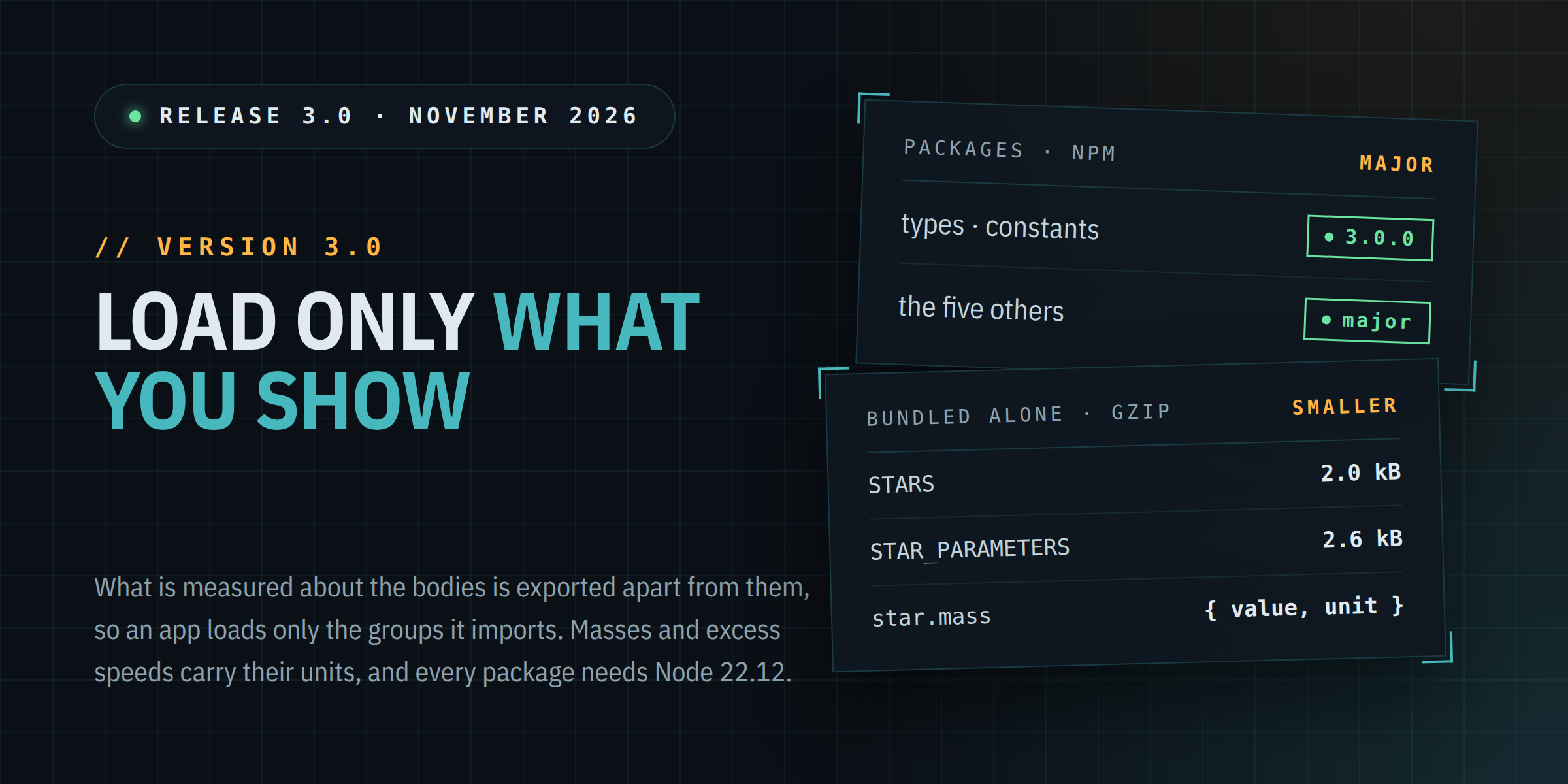
Every package gets a major release: types and constants go to 3.0.0, temporal, equations and mcp to 2.0.0, and maps and tracking, still below 1.0, to 0.12.0 and 0.13.0.
These notes cover what changed between 2.x and 3.0. For the code changes, step by step, see the migration guide from 2.x to 3.0. Questions? See getting help.
Overview
2.x added a lot of measured data to the bodies: the stars' temperatures, luminosities, positions and motions, the giant planets' rings, the interstellar objects' orbit solutions, the Sun's heliosphere. All of it lived on the bodies, so an app that imported STARS to draw a star map loaded every source, note and error bar with it.
3.0 keeps what draws and moves a body in the datasets, and exports what is measured about it apart, so an app loads only what it imports. It also gives masses and excess speeds the units they only had in comments, and asks for the Node version where require() loads these ES modules.
It matters to you if you read a body's observations, its display.rings or display.astrosphere, a star's mass, a black hole's mass, or an interstellar object's orbit.excessSpeed, or if you run on Node 22.9 to 22.11.
What's new
Observations apart from the bodies
STARS, PLANETS, MOONS and INTERSTELLAR_OBJECTS carry the id, name, type, parent, orbit, rotation, radius, mass and colour of each body. What is measured about them is exported apart, keyed by body id, each group in its own module so a bundler leaves out the ones an app doesn't import:
| Export | What | Bundled alone |
|---|---|---|
STAR_PARAMETERS | spectral class, temperature, luminosity, log g, [Fe/H] | 2.6 kB |
STAR_ASTROMETRY | catalogue ids, position, motion, V magnitude, component | 2.4 kB |
HELIOSPHERE, HELIOSPHERE_DISPLAY | the Sun's heliosphere and the Voyagers' crossings, and how to draw it | 0.8 kB |
PLANET_RINGS | the giant planets' rings and gaps | 1.8 kB |
RING_DISPLAY | how to draw them | 0.5 kB |
MOON_RING_ROLES | the moons whose dust feeds a ring | 0.1 kB |
INTERSTELLAR_OBJECT_OBSERVATIONS | orbit solutions, radiants, magnitudes | 1.2 kB |
DISCOVERIES | discovery dates and sites | 0.3 kB |
Sizes are minified and gzipped. STARS on its own is 2.0 kB, from 7.5 kB in 2.x.
import { STAR_PARAMETERS, STARS } from '@interstellar-tools/constants';

for (const star of STARS) {
  const parameters = STAR_PARAMETERS[star.id];
  const kelvin = parameters?.effectiveTemperature?.value; // 9845 for Sirius A
}
For everything on one object, as in 2.x, withObservations and withDisplay put the groups back on the bodies:
import {
  HELIOSPHERE,
  STAR_ASTROMETRY,
  STAR_PARAMETERS,
  STARS,
  withObservations
} from '@interstellar-tools/constants';

const stars = withObservations(STARS, STAR_PARAMETERS, STAR_ASTROMETRY, {
  sun: { astrosphere: HELIOSPHERE }
});
The MCP server does exactly that, so its dataset resources still give an assistant the bodies whole.
Masses and excess speeds with their units
A star's mass and a black hole's mass are MassInterface, in solar masses, and an interstellar object's orbit.excessSpeed is SpeedInterface, in km/s, like every other measure in the datasets:
| Field | 2.x | 3.0 |
|---|---|---|
star.mass | 2.135 | { value: 2.135, unit: 'M_sun' } |
galaxy.blackHole.mass | 4.2996e6 | { value: 4.2996e6, unit: 'M_sun' } |
object.orbit.excessSpeed | 26.39 | { value: 26.39, unit: 'km/s' } |
convertQuantity from @interstellar-tools/equations converts them, to kg or m/s for example.
Node 22.12 or later
Every package's engines asks for Node 22.12. The packages are ES modules, and require() loads them from Node 22.12; on 22.9 to 22.11 it fails with ERR_REQUIRE_ESM.
What's not changing
- The values. No measurement changes in 3.0: the groups hold what the bodies held in 2.15.
mu. It stays a number in m³/s², as the equations take it.- The types of
observationsanddisplay. The body interfaces keepobservationsand the display groups as optional fields, the shapewithObservationsandwithDisplaygive. - The other APIs.
temporal,equations,mapsandtrackingchange only theirengines, andmcpserves the same resources.
Deprecated
Nothing new.
Removed
| Removed | Use instead |
|---|---|
observations on the bodies in STARS, PLANETS, MOONS and INTERSTELLAR_OBJECTS | the groups above, or withObservations |
display.rings and display.astrosphere on the bodies | RING_DISPLAY and HELIOSPHERE_DISPLAY, or withDisplay |
Neither was deprecated first: the groups were added in 2.15, a week before 3.0, and the observations themselves only since 2.9.
FAQ
Do I need to upgrade right away?
No. types and constants 2.x, and temporal, equations and mcp 1.x, get fixes for high and critical vulnerabilities for 6 months after 3.0, as the security policy describes. But only 3.0 lets an app leave out the observations it doesn't show.
How big is the upgrade?
Small for most apps. If you read .mass or .excessSpeed, add .value. If you read a body's observations, import the group instead, or put the groups back with withObservations. The migration guide has a checklist.
Upgrade all the packages together, so they share one copy of types.
Does this change how the MCP server is set up?
Only its Node version: it needs 22.12 or later, like the other packages. Its resources give the same bodies, with their observations.
Getting help
- Something doesn't work after upgrading? Check the migration guide, then open an issue with the package versions and a short example.
- A question? Open an issue too; questions are welcome.
- A security problem? Don't open an issue. Report it privately, as the security policy describes.