

1.0 release notes October 2026
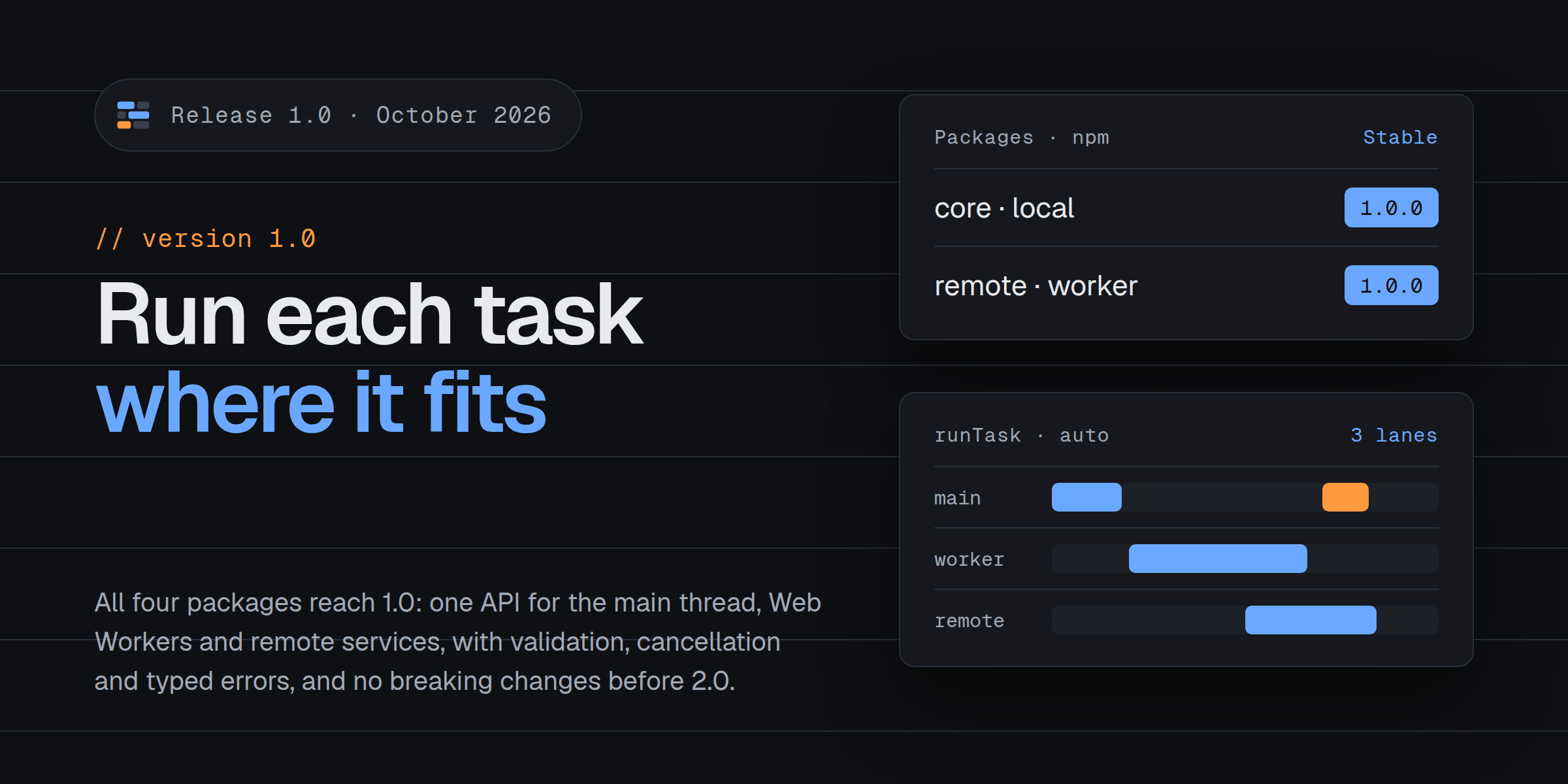
All four packages go to 1.0.0 together: core, local, remote and worker.
These notes cover everything that changed between the 0.x releases and 1.0. For the code changes, step by step, see the upgrading guide. Questions? See getting help.
Overview
1.0 is a promise more than a feature: from 1.0 on, the public API only breaks in a major release. Every function, option, error type and message format you use today keeps working through every 1.x release.
To make that promise, each package had an API review in October 2026, with the findings and decisions recorded in its issue. The reviews didn't add much surface; they made what was there dependable:
- Nothing fails silently. Bad options and arguments throw straight away, with a message that says what to change. No task waits forever: remote tasks time out, crashed workers reject their tasks, and every task can be cancelled.
- One error type per backend.
NoBackendErrorwhen nothing can run a task,RemoteTaskErrorandWorkerTaskErrorwhen a task fails, each with the task name and the details, so you can match on the type instead of the message. - Built for bundlers and modern runtimes. ES2022 ES modules with an
exportsmap, source maps that resolve, and acreateWorkeroption that Vite and webpack understand.
If you're on 0.38 or later, most of the work is behind you. If you're on 0.37 or older, the upgrading guide has a checklist.
What's new
Cancelling any task
runTask takes an AbortSignal, on every backend:
const controller = new AbortController();
const result = compute.runTask('resize', image, 'auto', {
  signal: controller.signal
});

controller.abort(); // result rejects with the signal's reason
local tasks and exposeTasks workers get the signal as run(input, { signal }), so long-running work can stop early. remote aborts the request.
@hybrid-compute/core
- Validation: the backends passed to
createHybridCompute, and the task name and strategy passed torunTask, are checked, with aTypeErrororRangeErrorfor mistakes. NoBackendErrorwhen no backend can run a task, with itstaskNameandstrategy.canRunfor every strategy: an explicit'local','worker'or'remote'now checks the backend can run the task, asautoalways did.- No runtime dependencies.
@hybrid-compute/local
registerTaskchecks the task and refuses a name that's already registered;unregisterTask(name)removes one.- A task's
runcan return a plain value or a Promise, and gets the caller'ssignal.
@hybrid-compute/remote
canRunTasksis required: list the tasks the server runs, or pass'*'. Before, leaving it out sent any task to the server.RemoteTaskErrorfor every failure, with the server's error asdetail, the HTTPstatusand thecause.- A 30 second timeout by default, set with
timeout. - A WebSocket that connects when needed: on the first task, again after it closes, with
close()to end it. headersfor the fetch transport, as an object or a function, for example to send a fresh token.- Typed messages:
RemoteTaskRequestInterfaceandRemoteTaskResponseInterfacedescribe what your server receives and sends.
@hybrid-compute/worker
- An options object:
createThreadedCompute({ createWorker, canRunTasks, timeout }), orurlfor a script served without a bundler. createWorker, so Vite and webpack build the worker script. Passing a barenew URL(...)didn't work with either.exposeTaskswrites the worker script for you: tasks by name, errors as replies, and cancelling.WorkerTaskErrorfor every failure, and no more hanging tasks: a crash or a script that doesn't load rejects every waiting task, and the next task starts a new worker.close()terminates the worker.
WebAssembly
WebAssembly needs no backend of its own: a module's exports are functions, so they run as local tasks or in a worker with exposeTasks. The new WebAssembly guide shows both with a Rust example.
Trust and quality
- Published with provenance from GitHub Actions with npm trusted publishing, with a CycloneDX SBOM attached to every GitHub release. Check what you installed with
npm audit signatures. - Every tarball is checked before it's published: packed, linted with publint and
@arethetypeswrong/cli, installed and imported. - Tests at 99% of lines or more in every package, enforced in CI, with property-based tests for dispatch, the local registry and message round-trips, and real threads and a real HTTP and WebSocket server instead of mocks.
- The OpenSSF Best Practices passing badge, and most of silver.
What's not changing
- The four packages and what they're for.
coredispatches,local,workerandremoterun tasks. - The strategies:
'auto','local','worker'and'remote', and theautoorder: worker, then local, then remote. - The message format.
{ task, input }out,{ result }or{ error }back, with anidon both for workers and remote WebSockets. - Node.js 22 or later, as before.
Deprecated
Nothing. 1.0 is the first release with a deprecation policy: from now on, deprecated APIs keep working through one full major. See deprecations.
Removed
Nothing that was documented. The positional createThreadedCompute(url, taskNames) and an optional canRunTasks for remote changed shape during 0.x; see the upgrading guide.
FAQ
What do I get from 1.0?
Stability. Within 1.x, npm update never needs a change to your code, and the security policy supports 1.x as a whole.
Do I need to upgrade right away?
0.x gets no more releases now that 1.0 is out, including security fixes. If you're on 0.38 or later, upgrading is mostly bumping the versions.
How big is the upgrade?
From 0.38 or later: update the versions, and check your error handling matches on the new error types. From 0.37 or older: about one change per backend you use, listed in the upgrading checklist.
What about Node.js worker threads?
The worker backend uses Web Workers, so it runs in browsers, Deno and Bun. Support for Node.js worker_threads is planned after 1.0, in #127. Where there are no Web Workers, canRun is false, so auto uses another backend.
Getting help
- Questions and ideas: open a discussion or issue.
- A bug in 1.0: open an issue with the package version and a small example.
- A security problem: report it privately, as the security policy describes.